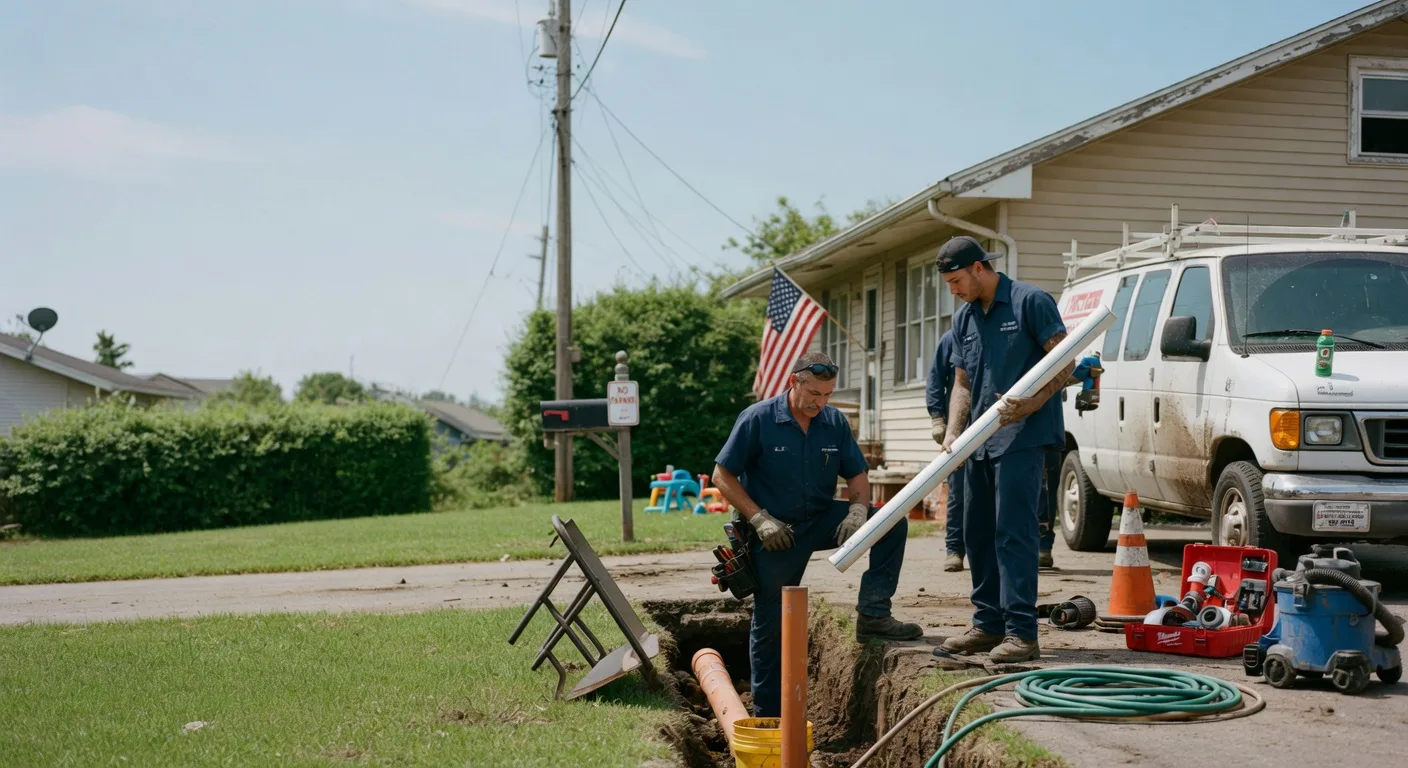
My drains back up every autumn. Why is it seasonal?
That pattern is a clue. Drains that back up every autumn usually have a fixed fault that the season exposes.
Roots chase moisture and grow most actively in the warm months. A clay joint that was passable in spring can be choked by late summer. Then the first heavy autumn rain loads a line that was already marginal, and it backs up.
Leaves are the second cause. Leaves and seed debris wash into a yard drain, a window well or an open cleanout and pack the line. A third cause is a blocked vent stack. Leaves over the roof opening cause gurgling and slow flow without any clog in the pipe.
Safe homeowner check: clear the gutters and the yard drain grate, lift leaves out of the window well, and check that the cleanout cap is seated. Listen for gurgling after a toilet flush.
Stop running water and call now if every drain in the house is slow or backing up, if the lowest tub or floor drain bubbles or fills, or if sewage odor is strong. Those signs point to the main line or a failed sewer lateral. Water used in the house only adds to the backup. Emergency Drain Cleaning calls come from exactly this situation.
A single slow fixture is a cable job. A line that clogs on a schedule is a camera inspection case, because the interval is a symptom of a fixed fault. The camera shows whether it is root intrusion, a bellied section or a damaged joint. Hydro jetting clears the line, and the repair deals with the cause.
Expert Plumbers Co is a referral service. We refer homeowners in Cement, OK to an independent local plumber. Call (380) 262-9173.
Keep a simple log. Note the date, the weather and which fixtures backed up each time. If the dates cluster on rainy days, a storm load or root problem fits. If they follow leaf fall in dry weather, look first at the vent stack and the outside drains. Hand the log to the plumber. It saves a lot of guessing.
If you can plan ahead, book a camera inspection in late summer, when roots are at their thickest and the line is not under storm load. Cutting roots back then, before the rain, is a calmer job than an overnight backup.
Be wary of root-killing foam as a cure. It can slow regrowth, but it does not repair the joint where the roots get in, and they return. Shallow-rooted trees near the lateral, such as willows and maples, are repeat offenders, so mention what grows near the line. Learn where your cleanout is before you need it.
We run a cafe and the kitchen line keeps blocking. Is that the same job as a house drain?
Not quite. A kitchen line that blocks again and again is usually a grease problem, and that is a different job from a house drain.
A cafe pushes far more fat, oil and food solids down the pipe than a home does. The grease cools, sticks to the pipe wall and builds layer on layer. The opening shrinks each week. That is why the blockage returns on a short cycle.
A grease interceptor, also called a grease trap, sits between the kitchen and the main line. It catches fat before it travels downstream. It only works while it has room. Once it is overfull it stops holding grease and passes it straight into the line. So it needs servicing on a schedule, not just when something goes wrong. Many jurisdictions require an interceptor and expect records of each servicing. That is a code matter, so check with your local authority.
A cable machine punches a channel through the grease and leaves the coating on the wall. Water drains for a while, then the channel closes again. A commercial line usually needs hydro jetting, which uses high-pressure water to strip the wall clean. A camera inspection then checks the pipe underneath for cracks, roots or a sag that holds water.
One slow sink is a branch problem. Every fixture backing up points to the main line.
A blocked line in a food business is a shutdown risk, so timing matters. If water is rising near the prep area, stop using the sinks and call.
What the job involves depends on access to the line, how much has to be opened up, the condition of the pipe and any permit requirement. Expert Plumbers Co is a referral service. Call (380) 262-9173 and we will refer your cafe to an independent local plumber in Cement, OK.
Keep a servicing record and a routine. Write down the date each interceptor is serviced and by whom. Authorities that require interceptors usually ask to see those records.
Train kitchen staff on what goes down the drain. Scrape plates and pans into the trash first, fit fine mesh strainers in every sink, and never pour fryer oil down any drain, even with hot water, because it cools further down the line and sets. Hot water and soap only move grease along the pipe. They do not remove it.
Learn the warning signs of a full interceptor: slow draining at the sinks nearest it, a sour or rancid smell, or grease showing in the outlet chamber.
Set the jetting interval after a camera inspection shows how fast the coating builds, so cleaning happens before a lunch rush is lost to a backup. Mention any recent menu change toward fried or fatty food when you call.
Our older house has a house trap, or running trap, in the basement. Why does it keep clogging?
Your basement drain backs up every so often, and each time someone points at the house trap and clears it again. In an older house that is a familiar story.
A house trap, also called a running trap, is a U-bend on the main drain near the foundation wall, with two cleanout plugs. It holds water to keep sewer air out. The trouble is that the dip slows the flow and gives solids a place to settle. Paper, grease, wipes and roots that pass through a straight pipe pile up in the bottom of the bend, so the trap becomes a frequent stoppage point.
Old lines make it worse. Scale in cast iron roughens the pipe and catches debris before it reaches the trap. Root intrusion at a clay joint outside sends fibres toward it. A bellied line downstream can hold water back so the trap never fully clears. Many traps were removed over the years, and local code on keeping or removing one varies.
One slow fixture is usually its own branch problem. If toilets, tubs, sinks and the washer all slow down together, or the floor drain bubbles, the trap or the main beyond it is the likely spot.
Safe homeowner check: Stop using water and look at the two trap plugs without opening them. Check whether the floor drain is holding water, and note which fixtures back up first.
Stop running water and call now if sewage is coming up from a floor drain or shower, if you smell sewage in the basement, or if a plug is weeping. Never loosen a trap plug under pressure, because sewage can surge out.
A cable machine is often enough to clear the trap itself when the stoppage is soft. Hydro jetting is the better choice when grease or scale lines the pipe on either side. A camera inspection is the right step when the trap keeps clogging, because it shows whether the real fault is a belly, a root-filled joint or a failing section further down.
Expert Plumbers Co is a referral service. We connect you with an independent local plumber in Cement, OK. Call (380) 262-9173.
Ask whether the trap can stay and be cleaned when needed, or be removed where code allows. The scope depends on basement access, the condition of the pipe on both sides, how much floor has to be opened up, and any permit or code requirement for changing the main.
Do enzyme or bacterial drain treatments actually work?
Your drain is slow and the bottle on the shelf says it eats clogs. Does it work? A little, in the right situation, and no for most clogs people buy it for.
Enzyme and bacterial products break down organic film: grease, soap residue, food particles and the slimy layer that builds on the inside of a pipe. They work slowly, over days and repeated doses. Used that way, they help keep a clean line clean.
What they cannot do is just as important. They will not dissolve a hairball in a tub trap, a wad of wipes, a child's toy or a solid plug. They do nothing to tree roots growing into a clay joint. They cannot lift a bellied line that holds water, flatten a collapsed section, or seal a cracked pipe. Scale inside old cast iron is mineral, not organic, so it does not respond either.
If one fixture is slow, the cause is usually local: hair, soap scum or grease in that trap or branch. If every drain in the house is slow, or water backs up in the lowest fixture when you run the washer, the problem is in the main line, and a bottle from the shelf will not reach it.
Safe homeowner check: remove the stopper or strainer and clear what you can by hand. Try a plain plunger. Flush with hot tap water, not boiling, which can soften or damage some pipe and fittings. If you use an enzyme product, follow the label, usually at night when the drain sits unused. Do not mix it with chemical openers.
Stop running water and call now if sewage or gray water comes up in a tub, shower or floor drain, if the toilet and the sink back up together, if gurgling comes from several fixtures.
A cable machine is enough for a single soft clog or a simple plug in one branch. If the line keeps slowing down, a plumber may suggest hydro jetting to clean the full pipe wall, or a camera inspection to see roots, a belly or a damaged joint before anything else is done.
Expert Plumbers Co is a referral service. We connect you with an independent local plumber in Cement, OK. Call (380) 262-9173.
Ask the plumber what they found on the pipe wall, not just whether the water now runs. If it was grease or film, ask whether a maintenance routine makes sense for your line. If it was roots, a belly or damage, ask what repair is involved. The scope depends on access to the pipe, the materials needed, how much has to be opened up, and any permit or code requirement.
My bathtub has a lever on the overflow plate and it drains slowly. Where is the clog?
Your tub has a lever on the overflow plate, the one you flip to close the drain, and now the water sits around your ankles. It drains slowly, and you want to know where the clog is. It is usually in one of two places.
Trip-lever drains have a plunger, or a stopper and linkage, that runs down inside the overflow tube behind that plate. A rod and spring connect the lever to the stopper at the bottom. Hair and soap scum wrap around that linkage and build into a mat that restricts the opening, even when the tub looks empty. If the linkage is out of adjustment, the stopper may also sit partly closed, so water slips through a narrower gap than it should.
The second place is the trap below the tub. Most tubs use a P-trap, and that bend collects hair, soap, and grease from bath oils. A clog there slows the whole tub even when the linkage is clean.
If only the tub is slow and the sink and toilet in the same bathroom work, the clog is almost certainly in the linkage or the trap. If the sink, shower and toilet also run slow, or the tub gurgles when another fixture drains, the problem is in the branch or main line.
Safe homeowner check: unscrew the overflow plate, pull out the linkage slowly, and clean off the hair and gunk. Check that the lever lifts the stopper fully. Run hot tap water, not boiling, to flush the drain. Avoid chemical openers.
Stop running water and call now if water backs up in the tub when the toilet or sink is used, if you see sewage, if there is water on the floor or ceiling below, or if a strong sewer smell shows up with the slow drain.
A cable machine is enough for a hair clog in the trap or a short branch. If the tub keeps slowing down, or several fixtures are involved, a camera inspection shows whether the cause is roots, a belly or grease coating the pipe. Hydro jetting is worth considering when the pipe wall is coated rather than plugged.
Expert Plumbers Co is a referral service. We connect you with an independent local plumber in Cement, OK. Call (380) 262-9173.
Ask the plumber whether the clog was in the linkage, the trap or further along, and whether the stopper needs replacing or adjusting. If the tub sits over a finished ceiling or is set in tile, ask how they plan to reach the trap. The scope depends on access, the parts or materials needed, how much has to be opened up, and any permit or code requirement.